Arcanum 8: Justice
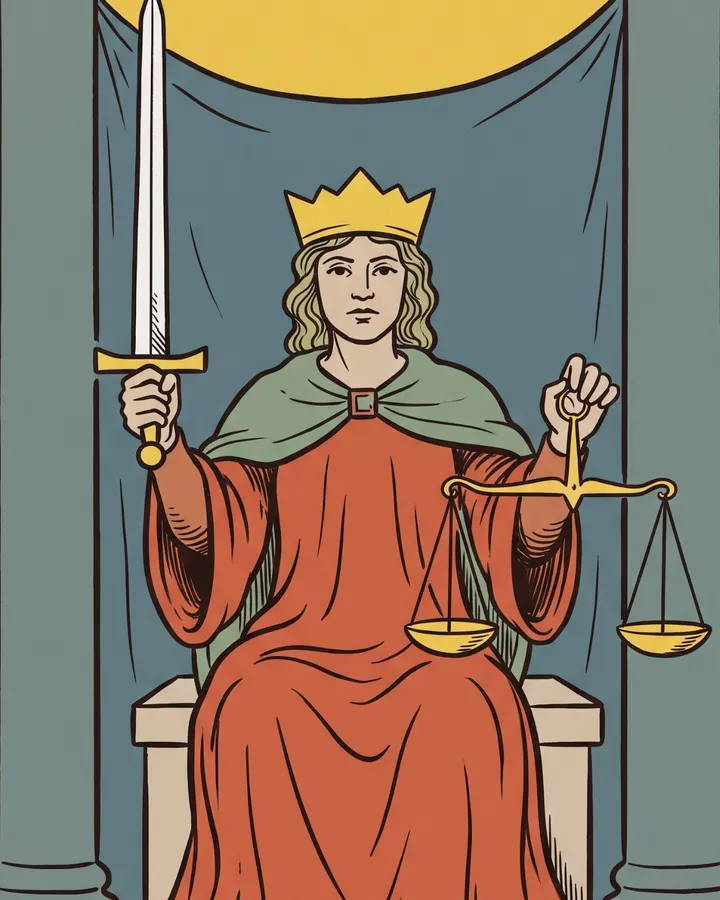
Balanced fairness
You put both sides’ arguments on the scales and only then say what is fair.
Justice sits on a throne before a dark curtain, holding scales in one hand and an upright sword in the other. The scales weigh both sides and the sword cuts through hesitation. On the scales go honest accounts: what each person is owed, what was promised and the consequences of your decisions.
Gifts and potential pitfalls
- Gift
- You make sure the same rules apply to everyone, including yourself. You deliver your verdict calmly and plainly.
- Shadow
- Keeping score can go on endlessly: who contributed what and who owes whom. Such accounting often proves harshest towards yourself.
- First step
- Tell one person directly what you consider a fair division in a matter you share.
In a pair
When this arcanum is at the centre of a shared matrix:
You weigh shared matters openly: each says what they give and what they need.
In the karmic tail
When this arcanum appears at one of the three points below the centre:
In someone else’s dispute, you quickly see who is right and feel someone should finally say so. You are less likely to check whether anyone asked for a verdict. Before giving one, ask: “Do you want my assessment, or do you just want to talk?”
Where this arcanum appears in the matrix
The centre and other points are sums, so this arcanum can appear for many different dates. Three points depend directly on the date:
- Point A (personality): birth day: 8, 26 (2 + 6 = 8).
- Point B (birth month): August.
- Point C (sum of birth-year digits), 1900–2026: 1979 (1 + 9 + 7 + 9 = 26, 2 + 6 = 8), 2015 (2 + 0 + 1 + 5 = 8), 2024 (2 + 0 + 2 + 4 = 8). Number of such years: 6.
Matrix number and card number
In the 1909 deck Justice is XI and Strength is VIII. In the matrix the order is reversed: Justice is 8 and Strength is 11.